Friday, March 18, 2011
jets to benghazi.
one small step for liberalism, one giant leap for multilateralism. finally.
oh and speaking of multilateralism...
phew! what a week.

Tuesday, March 1, 2011
death and taxes.
it's tax time and it's time to correct some abounding misperceptions! i think the best way to do is just post a little tit for tat i had with a misperceiver who quoted this...
From the US Treasury and Office of Tax Analysis:
# In 2002 the latest year of available data, the top 5 percent of taxpayers paid more than one-half (53.8 percent) of all individual income taxes, but reported roughly one-third (30.6 percent) of income.
# The top 1 percent of taxpayers paid 33.7 percent of all individual income taxes in 2002. This group of taxpayers has paid more than 30 percent of individual income taxes since 1995. Moreover, since 1990 this group’s tax share has grown faster than their income share.
# Taxpayers who rank in the top 50 percent of taxpayers by income pay virtually all individual income taxes. In all years since 1990, taxpayers in this group have paid over 94 percent of all individual income taxes. In 2000, 2001, and 2002, this group paid over 96 percent of the total.
Treasury Department analysts credit President Bush's tax cuts with shifting a larger share of the individual income taxes paid to higher income taxpayers.
America’s lowest-earning one-fifth of households receives roughly $8.21 in government spending for each dollar of taxes paid. Households with middle-incomes receive $1.30 per tax dollar, and America’s highest-earning households receive $0.41 per tax dollar;
and my response:
ok i think i see what you're missing here. what you quote uses the irs definition of income tax. yes, as far as "income tax" goes, it is purely progressive, and you pay more as you make more. what you don't see is that income tax isn't the only tax people pay. that misses the taxes on income from capital gains, and thus misses the bigger picture. that's why i went out and found the bigger picture for you...
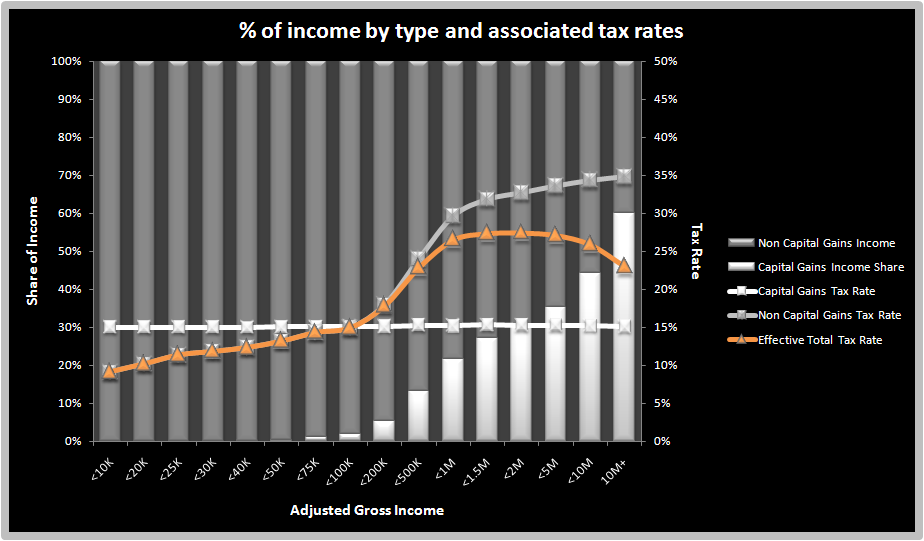
don't worry, it's a common mistake. but any economist will tell you, there is no disputing that according to *effective* tax rates the us tax code is regressive in favor those who make $1.2 million+. effective tax rates are a much truer measure of tax burden than statutory tax rates, and it's manipulated all the time: http://seekingalpha.com/article/92485-statutory-vs-effective-tax-rates
also, you should be careful with those figures you quoted. they may actually be more a reflection of growing income inequality than a progressive tax system. think about it this way: imagine the top 5% made literally *all* the income and everyone else made literally 0. see how amazing the quotes could be now? the rich pay all taxes! oh how noble of them!
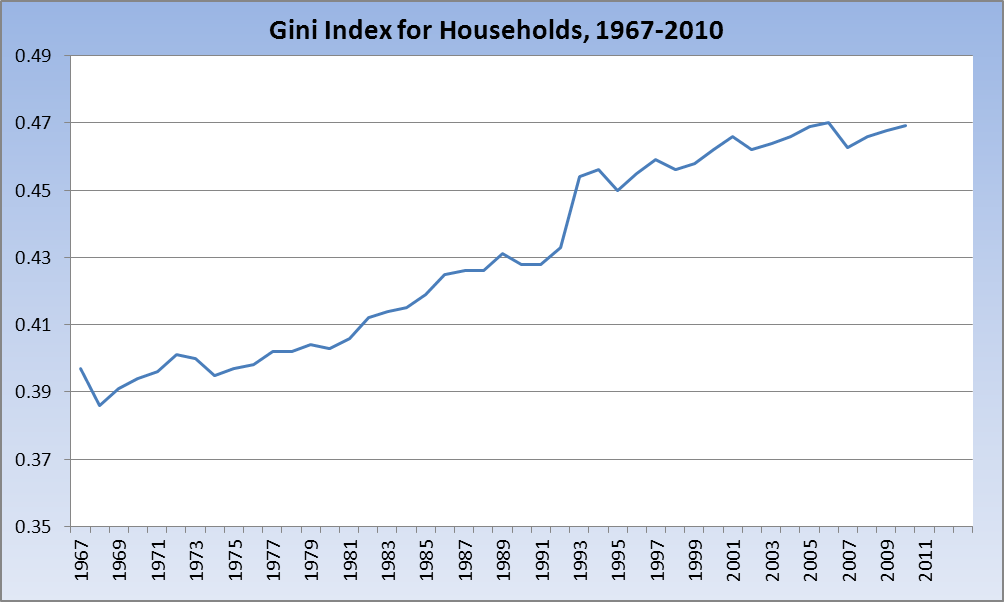
p.s. "The wealthier you are, the greater a percentage of your wealth goes to the gov't." nope. not once you make 1.2 million+. another fun tidbit, that first chart shows how effective tax rate dips after 2 million "gross income." but again, details details... gross income is before expenses. (see: gross vs net.) in actuality, it starts to dip after 1.2 million net income...
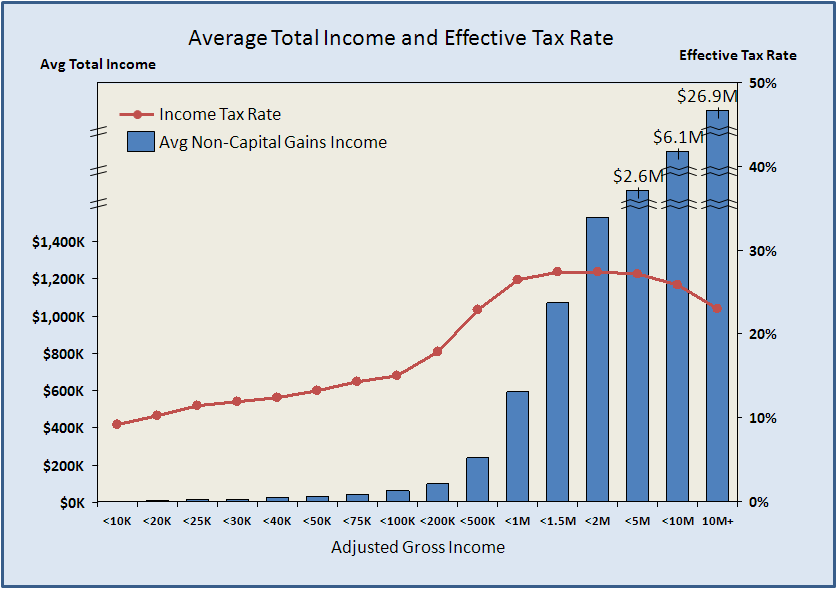
isn't critical reasoning fun?
and as always... http://www.wallstats.com/deathandtaxes/
From the US Treasury and Office of Tax Analysis:
# In 2002 the latest year of available data, the top 5 percent of taxpayers paid more than one-half (53.8 percent) of all individual income taxes, but reported roughly one-third (30.6 percent) of income.
# The top 1 percent of taxpayers paid 33.7 percent of all individual income taxes in 2002. This group of taxpayers has paid more than 30 percent of individual income taxes since 1995. Moreover, since 1990 this group’s tax share has grown faster than their income share.
# Taxpayers who rank in the top 50 percent of taxpayers by income pay virtually all individual income taxes. In all years since 1990, taxpayers in this group have paid over 94 percent of all individual income taxes. In 2000, 2001, and 2002, this group paid over 96 percent of the total.
Treasury Department analysts credit President Bush's tax cuts with shifting a larger share of the individual income taxes paid to higher income taxpayers.
America’s lowest-earning one-fifth of households receives roughly $8.21 in government spending for each dollar of taxes paid. Households with middle-incomes receive $1.30 per tax dollar, and America’s highest-earning households receive $0.41 per tax dollar;
and my response:
ok i think i see what you're missing here. what you quote uses the irs definition of income tax. yes, as far as "income tax" goes, it is purely progressive, and you pay more as you make more. what you don't see is that income tax isn't the only tax people pay. that misses the taxes on income from capital gains, and thus misses the bigger picture. that's why i went out and found the bigger picture for you...
don't worry, it's a common mistake. but any economist will tell you, there is no disputing that according to *effective* tax rates the us tax code is regressive in favor those who make $1.2 million+. effective tax rates are a much truer measure of tax burden than statutory tax rates, and it's manipulated all the time: http://seekingalpha.com/article/92485-statutory-vs-effective-tax-rates
also, you should be careful with those figures you quoted. they may actually be more a reflection of growing income inequality than a progressive tax system. think about it this way: imagine the top 5% made literally *all* the income and everyone else made literally 0. see how amazing the quotes could be now? the rich pay all taxes! oh how noble of them!
p.s. "The wealthier you are, the greater a percentage of your wealth goes to the gov't." nope. not once you make 1.2 million+. another fun tidbit, that first chart shows how effective tax rate dips after 2 million "gross income." but again, details details... gross income is before expenses. (see: gross vs net.) in actuality, it starts to dip after 1.2 million net income...
isn't critical reasoning fun?
and as always... http://www.wallstats.com/deathandtaxes/
Sunday, February 27, 2011
 !
!
Monday, February 14, 2011
from maghreb to masses... definitely.
when i wake up tomorrow, i expect iran to be the headline. i want azadi square to look like tahrir square.
i'm so tired from partying hard in chicago, but i just had to get this out there before tomorrow, or approximately 7 am est... what's happening in the middle east right now has the potential to be a fucking dream come true.

the whole thing was just so surreal. i got off work early friday and glanced at the tv in the hotel lobby on my way in and the whole world just froze up for a second. mubarak had resigned... i'll be honest, i didn't expect it at all. then as i sat on the bus, all these thoughts ran through my head that just kept blowing my mind...
what if a secular democratic government emerges? what if a credible liberal government stands up to israel and changes the whole discourse? what will happen to the blockade? what if this just keeps spreading further and further? what if this spawns a wave of nonviolent protest in palestine? what if free speech in the arab world reforms iraq's absurdly sectarian politics? what if this really is the rebirth of pan-arabism, but cast in secular liberal ideals? what if this reignites the protests in iran? what if this time they succeed? what if all the tyrants in the middle east, autocrats, zionists, and mullahs alike, are all scared shitless for all the best reasons?
of course another thought crossed my mind: what if everything goes horribly wrong? i was watching the celebrations on al jazeera when they tried to ask a protester "what do you think is next for egypt?" and the phone line kept cutting out. the symbolism was just too appropriate...
protester: we're all so proud! we've made history!
newcaster: yes, but i was asking, what do you think is next?
protester: what? i can't hear you! there are fireworks!
newscaster: i said, what do you think is next? for egypt? what will happen now?
protester: sorry you're breaking up- (line goes dead.)
i laughed, but i am so hopeful right now.
p.s. i've had the funniest conversations with cab drivers recently... i somehow always do.
i remember a couple years back i had an iraqi cab driver and he ended up coming into the party he took us to, and we talked about what life is like in sadr city in the middle of this ridiculous rager for like an hour. i'll post about my absurd somalian chicago cabbie later, but i could tell by his accent my richmond cab driver was arab. sure enough, he was north african and we got to chatting about the middle east.and we talked about iran. he said something i never want to have to hear again ever.
i'm so tired from partying hard in chicago, but i just had to get this out there before tomorrow, or approximately 7 am est... what's happening in the middle east right now has the potential to be a fucking dream come true.
the whole thing was just so surreal. i got off work early friday and glanced at the tv in the hotel lobby on my way in and the whole world just froze up for a second. mubarak had resigned... i'll be honest, i didn't expect it at all. then as i sat on the bus, all these thoughts ran through my head that just kept blowing my mind...
what if a secular democratic government emerges? what if a credible liberal government stands up to israel and changes the whole discourse? what will happen to the blockade? what if this just keeps spreading further and further? what if this spawns a wave of nonviolent protest in palestine? what if free speech in the arab world reforms iraq's absurdly sectarian politics? what if this really is the rebirth of pan-arabism, but cast in secular liberal ideals? what if this reignites the protests in iran? what if this time they succeed? what if all the tyrants in the middle east, autocrats, zionists, and mullahs alike, are all scared shitless for all the best reasons?
of course another thought crossed my mind: what if everything goes horribly wrong? i was watching the celebrations on al jazeera when they tried to ask a protester "what do you think is next for egypt?" and the phone line kept cutting out. the symbolism was just too appropriate...
protester: we're all so proud! we've made history!
newcaster: yes, but i was asking, what do you think is next?
protester: what? i can't hear you! there are fireworks!
newscaster: i said, what do you think is next? for egypt? what will happen now?
protester: sorry you're breaking up- (line goes dead.)
i laughed, but i am so hopeful right now.
p.s. i've had the funniest conversations with cab drivers recently... i somehow always do.
i remember a couple years back i had an iraqi cab driver and he ended up coming into the party he took us to, and we talked about what life is like in sadr city in the middle of this ridiculous rager for like an hour. i'll post about my absurd somalian chicago cabbie later, but i could tell by his accent my richmond cab driver was arab. sure enough, he was north african and we got to chatting about the middle east.and we talked about iran. he said something i never want to have to hear again ever.
he said, "the iranians need to be brave. we lost hundreds for our freedom, and when some girl dies in iran, they all go home."
aside from me not being sure what he was talking about, and aside from him having the chronology pretty mixed up, he did have some semblance of a point. the iranian protest movement is so far still a disappointment, but it doesn't have to stay that way. take note.
Tuesday, February 1, 2011
from maghreb to masses... maybe.
hopefully. but it's up to the army.

now here comes the pessimism: revolution is a messy thing. the surrounding optimism exhibits a pattern something akin to an economic bubble, so maybe it's apt we're naming revolutions after flowers now. like the dutch tulip mania, so may go the jasmine revolution.
consider myself the example. a few transitive properties removed, this post is the product of a revolution that began with massive popular support. in the run-up to the islamic revolution in iran, democratic reformers, liberals, secularists, communists, and islamists alike all poured into the streets, suddenly and swiftly overwhelming the security apparatus of the shah.
so here's the thing... what happens next?
collapsing a regime is easier than creating one. in any regime change, be it externally or internally catalyzed, dismantling the current regime is often frighteningly easy. from iran to the soviet union, revolutions come swiftly and unexpectedly. from iraq to tunisia, catastrophic victories abound, and we're still not sure what perverse equilibrium of competing coercions will replace them.
a state is built upon a monopoly of coercion, and in some cases more than others, upon a perceived monopoly of coercion. and who holds more ability to coerce than the military? it's no coincidence that many regimes erect some sort of parallel military like saddam's fedayeen or iran's revolutionary guards... the amount of coercive power concentrated in the military is too great to leave unpoliced, and this is even more so when an unrepresentative minority is maintaining power.
in tunisia, the fate of the revolution was decided when the real referee revealed itself and army commander rashid ammar pledged to "protect the revolution." until then, what was "the revolution" anyway besides a bunch of dissimilar street cart vendors and lawyers angry over issues as divergent as hunger and internet censorship? but in an instant, president ben ali was fleeing the country and the head of the president's security apparatus ali seriati was under arrest, accused of threatening state security by fomenting violence despite quite literally being the state only moments earlier. what will become of the rcd and tunisia's one-party system is yet to be determined, but if i had to guess it doesn't look like mohamed ghannouchi is going to be around for very long.
now the question remains, is tunisia the arab gdańsk?
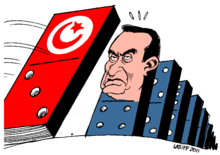
tunisia is not egypt, and egypt is not tunisia. that's not to say that the success of popular protest movements can't inspire other popular protest movements, but this is not a reawakening of pan-arabism. while ben ali has fled, mubarak is holding on. like tunisia, the military holds all the cards and can play kingmaker with a nod, but unlike tunisia, mubarak is a military man whose rule is a linchpin of stability in the middle east, and the whole world including me is afraid of what might come next.
of course hizb ut-tahrir and nahda are hoping to reenter tunisian politics, but tunisia has much more effectively purged itself of islamism, albeit through the regime's brutality and something like 1/5 of the population being on the secret police payroll at one time or another. the muslim brotherhood, on the other hand, is alive and well in egypt and is watching closely. here's a little tidbit from stratfor...
whether mubarak stays or goes, at least one thing has already come of this... america's foreign policy has been laid bare for the hypocritical mess that it really is. ben ali and mubarak were/are both huge beneficiaries of american support, egypt being the number two american foreign aid recipient, mostly for playing nice with america's number one foreign aid recipient, israel. and therein lies the hypocrisy: america has long since sold out arab liberty and its own professed values to make the world safe for zionism, which is why we are in this dilemma in the first place.
now call me radical, but i am... democracy means nothing. liberal democracy means everything, liberalism being much more important than democracy. a state is a monopoly on coercion, and a liberal state exists for the sole purpose of removing coercion from circulation. you can gerrymander and manipulate an illiberal democracy from within or without to get the most vile and tyrannical governments imaginable, which is exactly the kind of government you get from hamas, hezbollah, and likud, where some citizens, be they sunni, shi'a, or jewish, are more equal than others.
paradoxically, the longer coercion is wielded by the state for purposes other than minimizing coercion and safeguarding individual liberty, the more freedom is forgotten and reprisal becomes the rallying cry. and that's why the world, unfortunately, has to be afraid of democracy in the middle east. the hypocrisy has gone on too long for america to suddenly reverse course without severe unintended consequences. arabs have been disenfranchised for so long in the name of defending an illiberal democracy sold as liberal that liberalism has been abandoned by a critical number of arabs as a viable solution to the region's problems, despite being exactly that.
that said, right now i'm inspired and hopeful but i've been disappointed before, so i'm cautiouslyyy optimistic.
i think my hope for a liberal egypt is something akin to the turkish model, a vigilant military that will step in to restore liberal democracy if democracy strays towards islamism, but will otherwise stand completely on the sidelines as the guarantor of secularism and individual liberty. my fear is that the muslim brotherhood will strategically ride "democracy ... like a train. you get on it, and get off once you reach your destination." to be sure, the muslim brotherhood stands ready to fill any power vacuum that might arise, so it's up to the army and cairo's neighborhood watch to ensure that doesn't happen.
looking ahead, if there is any man that has my trust in navigating the liberal dilemma in egypt, it's elbaradei, and last i heard the government has agreed to negotiate with him as the representative of the opposition. i'll be watching him closely. i wish him luck.
now here comes the pessimism: revolution is a messy thing. the surrounding optimism exhibits a pattern something akin to an economic bubble, so maybe it's apt we're naming revolutions after flowers now. like the dutch tulip mania, so may go the jasmine revolution.
consider myself the example. a few transitive properties removed, this post is the product of a revolution that began with massive popular support. in the run-up to the islamic revolution in iran, democratic reformers, liberals, secularists, communists, and islamists alike all poured into the streets, suddenly and swiftly overwhelming the security apparatus of the shah.
so here's the thing... what happens next?
collapsing a regime is easier than creating one. in any regime change, be it externally or internally catalyzed, dismantling the current regime is often frighteningly easy. from iran to the soviet union, revolutions come swiftly and unexpectedly. from iraq to tunisia, catastrophic victories abound, and we're still not sure what perverse equilibrium of competing coercions will replace them.
a state is built upon a monopoly of coercion, and in some cases more than others, upon a perceived monopoly of coercion. and who holds more ability to coerce than the military? it's no coincidence that many regimes erect some sort of parallel military like saddam's fedayeen or iran's revolutionary guards... the amount of coercive power concentrated in the military is too great to leave unpoliced, and this is even more so when an unrepresentative minority is maintaining power.
in tunisia, the fate of the revolution was decided when the real referee revealed itself and army commander rashid ammar pledged to "protect the revolution." until then, what was "the revolution" anyway besides a bunch of dissimilar street cart vendors and lawyers angry over issues as divergent as hunger and internet censorship? but in an instant, president ben ali was fleeing the country and the head of the president's security apparatus ali seriati was under arrest, accused of threatening state security by fomenting violence despite quite literally being the state only moments earlier. what will become of the rcd and tunisia's one-party system is yet to be determined, but if i had to guess it doesn't look like mohamed ghannouchi is going to be around for very long.
now the question remains, is tunisia the arab gdańsk?
tunisia is not egypt, and egypt is not tunisia. that's not to say that the success of popular protest movements can't inspire other popular protest movements, but this is not a reawakening of pan-arabism. while ben ali has fled, mubarak is holding on. like tunisia, the military holds all the cards and can play kingmaker with a nod, but unlike tunisia, mubarak is a military man whose rule is a linchpin of stability in the middle east, and the whole world including me is afraid of what might come next.
of course hizb ut-tahrir and nahda are hoping to reenter tunisian politics, but tunisia has much more effectively purged itself of islamism, albeit through the regime's brutality and something like 1/5 of the population being on the secret police payroll at one time or another. the muslim brotherhood, on the other hand, is alive and well in egypt and is watching closely. here's a little tidbit from stratfor...
"After three decades of Mubarak rule, a window of opportunity has opened for various political forces — from the moderate to the extreme — that preferred to keep the spotlight on the liberal face of the demonstrations while they maneuver from behind. As the Iranian Revolution of 1979 taught, the ideology and composition of protesters can wind up having very little to do with the political forces that end up in power. Egypt’s Muslim Brotherhood (MB) understands well the concerns the United States, Israel and others share over a political vacuum in Cairo being filled by Islamists. The MB so far is proceeding cautiously, taking care to help sustain the demonstrations by relying on the MB’s well-established social services to provide food and aid to the protesters. It simultaneously is calling for elections that would politically enable the MB."
whether mubarak stays or goes, at least one thing has already come of this... america's foreign policy has been laid bare for the hypocritical mess that it really is. ben ali and mubarak were/are both huge beneficiaries of american support, egypt being the number two american foreign aid recipient, mostly for playing nice with america's number one foreign aid recipient, israel. and therein lies the hypocrisy: america has long since sold out arab liberty and its own professed values to make the world safe for zionism, which is why we are in this dilemma in the first place.
now call me radical, but i am... democracy means nothing. liberal democracy means everything, liberalism being much more important than democracy. a state is a monopoly on coercion, and a liberal state exists for the sole purpose of removing coercion from circulation. you can gerrymander and manipulate an illiberal democracy from within or without to get the most vile and tyrannical governments imaginable, which is exactly the kind of government you get from hamas, hezbollah, and likud, where some citizens, be they sunni, shi'a, or jewish, are more equal than others.
paradoxically, the longer coercion is wielded by the state for purposes other than minimizing coercion and safeguarding individual liberty, the more freedom is forgotten and reprisal becomes the rallying cry. and that's why the world, unfortunately, has to be afraid of democracy in the middle east. the hypocrisy has gone on too long for america to suddenly reverse course without severe unintended consequences. arabs have been disenfranchised for so long in the name of defending an illiberal democracy sold as liberal that liberalism has been abandoned by a critical number of arabs as a viable solution to the region's problems, despite being exactly that.
that said, right now i'm inspired and hopeful but i've been disappointed before, so i'm cautiouslyyy optimistic.
i think my hope for a liberal egypt is something akin to the turkish model, a vigilant military that will step in to restore liberal democracy if democracy strays towards islamism, but will otherwise stand completely on the sidelines as the guarantor of secularism and individual liberty. my fear is that the muslim brotherhood will strategically ride "democracy ... like a train. you get on it, and get off once you reach your destination." to be sure, the muslim brotherhood stands ready to fill any power vacuum that might arise, so it's up to the army and cairo's neighborhood watch to ensure that doesn't happen.
looking ahead, if there is any man that has my trust in navigating the liberal dilemma in egypt, it's elbaradei, and last i heard the government has agreed to negotiate with him as the representative of the opposition. i'll be watching him closely. i wish him luck.
Subscribe to:
Posts (Atom)